

Introduction
The use of artificial intelligence is quickly changing the way we live, work, and interact. Ethical oversight has never been as necessary as it is now with AI systems issuing more decisions affecting people and society.
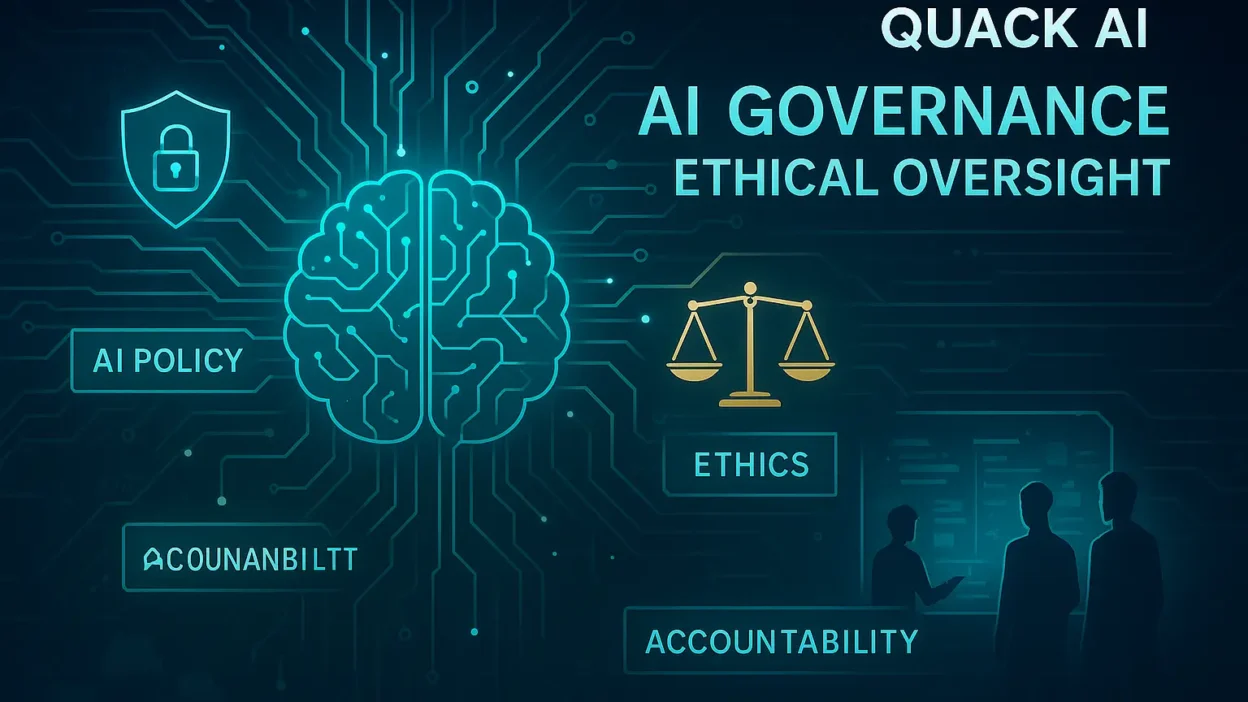
Quack AI Governance is becoming a holistic solution in order to make AI responsible, fair, and transparent.
This final document is going to guide you on the basics of Quack AI Governance, its major principles, the practical cases, and the actions that any organization can undertake to gain trust in their AI systems.
What Is Quack AI Governance?
Quack AI Governance is a formal system of managing the creation, implementation, and management of artificial intelligence. Quack AI Governance, in contrast to the traditional forms of governance, is heavily focused on ethics, transparency, and accountability. It has a strategy that aims at controlling risks and ensuring that AI can deliver maximum advantages to all stakeholders.
Why Is Ethical AI Oversight Important?
Unrestricted AI has the potential to increase prejudice, breach privacy, and make untransparent decisions. Ethical supervision is beneficial in that it aids in making AI systems fair, reliable, and in accordance with human values. The Quack AI Governance is the guiding hand, and it determines the design, implementation, and further improvement of AI.
Key Principles of Quack AI Governance
| Principle | Description |
| Transparency | Make AI systems and their decisions understandable |
| Fairness | Prevent and mitigate biases in data and algorithms |
| Accountability | Establish clear responsibility for AI outcomes |
| Security | Protect systems and data from misuse or breaches |
| Human-Centric Design | Ensure AI serves people, not the other way around |
| Continuous Oversight | Regularly monitor, audit, and update AI systems |
The Quack AI Governance Building Blocks
1. Transparency in AI Systems
Transparency refers to the ability to see and comprehend AI processes and decisions by users, regulators, and other interested parties. Quack AI Governance suggests that it should be clearly documented, should have explainable models, and should communicate openly about the way AI works and what it relies on data.
2. Dealing with Prejudice and Supporting Equity
The AI systems tend to mirror the bias in the training data. Quack AI Governance promotes frequent bias audits, multisource data, and design inclusivity. This will help avoid discrimination and make results equitable, particularly in sensitive fields such as the hiring process, lending process, or healthcare.
3. Responsibility Throughout the AI Lifecycle.
Should the AI system commit an error? Who is to bear the responsibility? Quack AI Governance assigns role and responsibility at each phase- starting with data collection to model deployment. This framework helps to deal with mistakes and respond to concerns more easily, and keep on enhancing practices.
4. Data Protection, Privacy, and Security.
Artificial intelligence systems work with extensive data, including its personal, sensitive information. Quack AI Governance establishes very rigid regulations regarding access to data, encryption, and privacy-by-design practices. This reduces the chances of violations or abuse.
5. Human-Centric AI
Human judgment is at the core of Quack AI Governance, as it improves but does not displace technology. It promotes systems that facilitate and do not dominate human decisions, particularly where the stakes are high.
Comparing Quack AI Governance to Traditional AI Oversight
| Aspect | Quack AI Governance | Traditional AI Oversight |
| Focus | Ethics, transparency, responsibility | Compliance, technical performance |
| Stakeholder Involvement | Multi-disciplinary, user-inclusive | Mostly technical or managerial |
| Adaptability | Continuous, flexible, responsive | Static, periodic reviews |
| Bias Management | Proactive audits, diverse input | Limited or reactive |
| Communication | Open and accessible | Internal or limited |
Regulatory Requirement and Compliance
Navigating Global AI Regulations
Ethical and regulatory standards of AI are changing rapidly. Quack AI Governance is consistent with the key frameworks, including the EU AI Act, OECD Principles of AI, and ISO standards. Integrating these requirements in the day-to-day operations of the organization will help the organization keep up with the regulations and prevent expensive fines.
Practical Compliance Steps
Trace all AI systems and applications in the company.
- Audit conduct risk and audit bias.
- Decision-making processes associated with documents and data sources.
- Give a transparency report and easier explanations.
- Make sure that the staff continues to be trained on the ethical practices of AI.
Real-Life Case: Quack AI Governance in Action.
An independent technology firm has developed an AI-based recruiting system to facilitate the process. There were criticisms of prejudice against particular crowds reflected in the initial feedback.
Through the implementation of Quack AI Governance, the organization had a comprehensive audit, engaged wider stakeholders, and re-trained the model using inclusive data. They also released a transparency report of their actions and outcomes. The result of this was more hiring and more trust between the applicants and the employees.
Implementing Quack AI Governance in Your Organization
Step 1: Build an AI Ethics Committee
Create an interdisciplinary team comprising of ethicists, data scientists, legal counsel, and user representatives. This committee is in charge of every step of AI development and implementation, with different opinions on possible risks and ethical issues.
Step 2: Develop Clear Policies and Guidelines
Record the way your organization deals with AI ethics, transparency, and accountability. Defined guidelines on the use of data, model explainability, user permission, and frequent audits. Have these policies and read them regularly.
Step 3: Invest in Training and Awareness
Make every employee, including developers and decision-makers, know the ethical principles of AI and be familiar with the most recent regulations. A culture of responsibility is attained through regular workshops and resources.
Step 4: Use Tools for Monitoring and Auditing
Use automated devices to track the performance of the AI systems, identify anomalies, and maintain an adherence to the governance standards. Arrange periodic external audit to examine the results and eliminate weaknesses.
Step 5: Encourage Open Communication.
Provide means of communication to users and stakeholders to complain, seek clarification or pose questions. Open communication fosters trust and creates improved and more humanistic AI systems.
Measuring the Success of AI Governance
Key Performance Indicators (KPIs)
- Less bias-related incidents or complaints.
- Share of AI systems that have been well documented and explainable.
- Ethics frequency and staff involvement.
- Ratings of stakeholder and user satisfaction.
- Status and audit outcome in terms of regulatory compliance.
Continuous Improvement
Quack AI Governance is not a single undertaking. KPIs should be reviewed and updated, and the organizations should learn to handle new developments in the field of AI and AI ethics.
The Future of Ethical AI Oversight
The role of the emerging technologies
Governance should be up-to-date with the advancement of AI. Quack AI Governance is flexible with the use of new tools of bias detection, explainability, and auditing. It also promotes partnership with regulating authorities, industry associations, and the general populace.
Building Public Trust
Trust in the cornerstones of transparency, fairness, and accountability. Through the adoption of Quack AI Governance, entities will be able to gain customer trust, hire the best people, and pioneer responsible innovation.
Frequently Asked Questions
Q: Does Quack AI Governance apply to big companies only?
No, it can be applied in businesses of all sizes. Begin and identifying your AI risks by mapping them and creating a culture of ethical responsibility.
Q: What is the frequency of the audit of the AI systems?
The best practice is to audit any significant update, as well as at least once a year (or more often with high-impact systems).
Q: What should they do in case the AI regulations alter?
Quack AI Governance is meant to be flexible. Constant checks and balances ensure continuity and flexibility.
Conclusion
Quack AI Governance is the final compass that helps a person who wants to manipulate the power of artificial intelligence to the highest integrity and with the mind of goodness.
Through the integration of ethical control, transparency and accountability in each phase of the AI life cycle, organizations can become innovative in a sustainable way. With AI further influencing society, ethical governors will not just be able to adjust to the changing laws, but they will be trusted and even have people as their users.
The principles of Quack AI Governance will help you start your journey today because the future of AI must be smart, fair, and, most importantly, human-centered.