


$30,000 a Year Is How Much an Hour? (Quick Answer)
If you’re earning $30,000 a year, your hourly pay comes out to about $14.42 per hour. This is based on a standard full-time schedule of 40 hours per week and 52 weeks per year.
That number gives you a quick snapshot. But your real hourly rate can feel different depending on your lifestyle, expenses, and how consistent your work hours are.
Think of it this way.
Every hour you work is just over fourteen dollars before taxes. That’s your starting point for budgeting, saving, and planning your day-to-day life.
If you work fewer hours or take unpaid time off, your effective hourly rate may shift. On the flip side, overtime or side income can push your overall earnings higher.
So while $14.42 is the simple answer, your real financial picture depends on how your time is structured.
How to Convert Salary to Hourly Pay (Simple Formula)
Turning a yearly salary into an hourly wage is easier than it sounds. You just need a simple formula:
Annual salary ÷ total hours worked in a year
For most full-time jobs, that means:
40 hours per week × 52 weeks = 2,080 hours per year
Now divide $30,000 by 2,080.
You get approximately $14.42 per hour.
Here’s a quick breakdown:
- Annual salary: $30,000
- Total yearly hours: 2,080
- Hourly rate: $14.42
This method works best if your schedule is consistent. If you work part-time, freelance, or variable hours, you’ll need to adjust the total hours.
It’s a small calculation, but it gives you clarity.
Once you know your hourly value, it becomes easier to compare jobs, negotiate pay, or plan side income.
$30,000 a Year Breakdown (Hourly, Weekly, Monthly)
Looking at your salary in smaller chunks makes it feel more real. Instead of one big number, you start to see how money flows into your life.
Here’s how $30,000 breaks down:
- Hourly: $14.42
- Weekly: about $577
- Monthly: about $2,500
That weekly amount is what you’re working with for groceries, bills, and small comforts. The monthly figure is what shapes your bigger decisions like rent, savings, and lifestyle.
It’s helpful to pause and picture this.
Two thousand five hundred dollars a month is your financial canvas.
How you divide it matters.
Some people prioritize a cozy home. Others focus on saving or paying off debt.
Breaking your salary down like this gives you control. It turns a fixed number into something you can actually design your life around.
Hourly Pay Based on Different Work Hours (Full-Time vs Part-Time)

Not everyone works the same schedule. And that changes how your $30,000 salary translates per hour.
If you work full-time at 40 hours per week, your hourly rate stays around $14.42. Simple and steady.
But if your hours shift, the math changes quickly.
For example:
- 35 hours per week: about $16.48 per hour
- 30 hours per week: about $19.23 per hour
- 20 hours per week: about $28.85 per hour
Same yearly income. Very different hourly value.
This is where things get interesting.
Working fewer hours can make your time feel more valuable, but it often means tighter scheduling or multiple income streams.
Full-time work offers consistency.
Part-time or flexible hours offer freedom.
Your ideal setup depends on what matters more to you right now. Stability or flexibility.
$30,000 a Year Is How Much Per Month?
On a monthly level, $30,000 a year comes out to about $2,500 before taxes.
This is the number most people actually live with. It’s what hits your bank account and shapes your everyday choices.
Picture your month for a moment.
Rent, utilities, groceries, transportation, maybe a little left for savings or something enjoyable.
That $2,500 needs to stretch across all of it.
After taxes, your take-home pay may drop closer to $2,000 to $2,200 depending on your location and deductions. That’s why planning matters.
A simple monthly structure can help:
- Housing: 30% to 40%
- Essentials: 30%
- Savings or debt: 10% to 20%
- Personal spending: the rest
It’s not about restriction.
It’s about making your money feel calm, organized, and enough for your lifestyle.
$30,000 a Year Is How Much Per Week?
When you break $30,000 down weekly, it comes to about $577 per week before taxes. This is based on a full 52-week year.
That weekly number is where your lifestyle really takes shape. It’s what you’re working with for groceries, transport, and those small everyday expenses that quietly add up.
Think of it as your weekly rhythm.
A little over five hundred dollars to manage everything life throws your way.
For many people, this means being intentional. Planning meals, watching subscriptions, and making thoughtful spending choices.
After taxes, your weekly take-home may feel closer to $450 to $500, depending on your situation.
It may not seem like a lot at first glance. But when managed well, it can still create a steady, simple lifestyle. The key is knowing exactly where each dollar goes before the week even begins.
$30,000 a Year Is How Much Per Day?
On a daily level, $30,000 a year works out to about $115 per day before taxes, assuming a 5-day workweek.
That’s the value of a single workday.
Pause and picture it.
Every day you show up, you’re earning just over one hundred dollars for your time and energy.
After taxes, that number may feel closer to $90 to $100 per day.
Breaking it down like this can shift your perspective. Small daily decisions start to matter more. A coffee here, a quick purchase there, it all connects back to your daily earnings.
It’s not about cutting everything out.
It’s about awareness.
When you see your income in daily terms, it becomes easier to decide what feels worth it and what doesn’t. That clarity can quietly transform how you spend and save.
What If You Work More or Less Than 40 Hours?
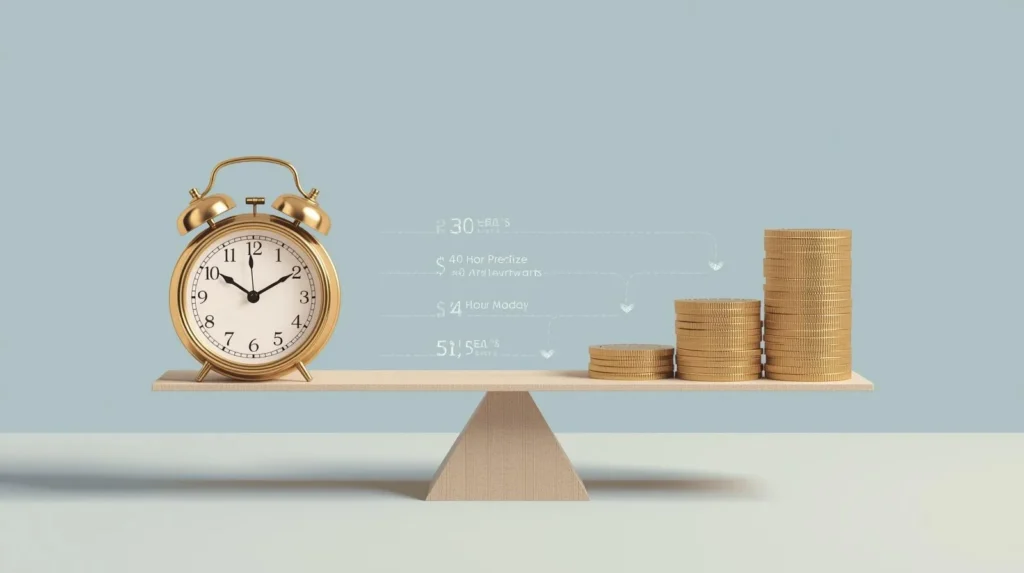
Your hourly value isn’t fixed. It changes depending on how many hours you work.
If you work more than 40 hours per week, your hourly rate actually drops when calculated from your salary alone. You’re spreading the same $30,000 across more time.
Work fewer hours, and the opposite happens. Your hourly rate increases because your time becomes more concentrated.
Here’s how it can shift:
- More hours worked = lower effective hourly rate
- Fewer hours worked = higher effective hourly rate
This is why your schedule matters just as much as your salary.
Some people prefer longer hours for stability and routine. Others choose fewer hours to create space for side hustles, rest, or personal projects.
There’s no one right answer.
It’s about how you want your time to feel.
Understanding this trade-off helps you design a work life that fits your priorities, not just your paycheck.
$30K Salary After Taxes (Real Take-Home Pay)
Your actual take-home pay is always lower than your salary. Taxes, deductions, and contributions all reduce that $30,000.
In most cases, you can expect to bring home around $24,000 to $26,000 per year after taxes. That’s roughly:
- $2,000 to $2,200 per month
- $460 to $500 per week
The exact amount depends on where you live, your tax bracket, and any deductions like healthcare or retirement contributions.
This is the number that truly shapes your lifestyle.
Not the salary on paper, but what lands in your account.
It’s helpful to build your budget around this realistic figure. That way, you’re not overestimating what you can spend.
Once you adjust to your true take-home pay, things feel more manageable. Clear, grounded, and easier to control.
Is $30,000 a Year Good Pay in 2026?

Content:
Whether $30,000 is “good” depends on your situation. There’s no one-size answer.
In lower-cost areas, it can support a simple, comfortable lifestyle. Think shared housing, mindful spending, and a slower pace of living.
In more expensive cities, it can feel tight. Rent alone may take up a large portion of your income, leaving less room for flexibility.
It also depends on your stage of life.
For someone just starting out, $30K can be a stepping stone. A place to learn, grow, and build better income opportunities.
For others, it may feel limiting long-term.
The key question isn’t just “Is it good?”
It’s “Does it support the life you want right now?”
With smart budgeting and intentional choices, $30,000 can still create a stable foundation. But for more comfort and freedom, many people aim to grow beyond it over time.
Can You Live Comfortably on $30K a Year?

Yes, you can live on $30,000 a year. But comfort depends on how you define it.
For some, comfort looks like a quiet, simple life. A small, cozy space. Home-cooked meals. Fewer distractions, more intention.
For others, comfort means flexibility, travel, or dining out often. That’s where $30K can start to feel limiting.
Your location plays a huge role. In a low-cost area, your money stretches further. In a high-cost city, it may feel tight very quickly.
Lifestyle choices matter just as much.
Minimalism, budgeting, and mindful spending can make this income feel calmer and more manageable.
It’s not about having everything.
It’s about creating a space and routine that feels peaceful, even within limits.
With the right balance, $30K can support a steady life. Not luxurious, but still warm, intentional, and enough for the basics.
Best Cities Where $30K Goes Further

Some places naturally make your money feel lighter. Others help it stretch.
If you’re working with a $30K salary, choosing the right city can completely change your experience. Smaller towns and affordable cities tend to offer lower rent, cheaper groceries, and less financial pressure.
Think places where life feels slower and more grounded.
Where you can afford a comfortable apartment without sacrificing your entire paycheck.
In general, look for:
- Lower housing costs
- Affordable public transport or walkable areas
- Reasonable grocery and utility prices
Cities in certain regions often offer this balance. Areas with lower population density or less demand usually come with lower living costs.
It’s not just about saving money.
It’s about breathing room.
When your essentials cost less, your income feels more flexible. You can enjoy your space, decorate it, and create a lifestyle that actually feels like yours.
Budget Example for a $30,000 Salary
A clear budget turns a tight income into something manageable. Even peaceful.
With about $2,000 to $2,200 monthly take-home pay, here’s a simple way to divide it:
- Rent: $700 to $900
- Groceries: $250 to $350
- Utilities: $100 to $150
- Transportation: $100 to $200
- Savings or debt: $200 to $300
- Personal spending: the rest
This isn’t strict. It’s a starting point.
Picture your space.
A small apartment with soft lighting, a cozy corner, maybe a plant or two. Everything intentional. Nothing overwhelming.
That’s what a thoughtful budget can create. Not just survival, but a calm environment where your money supports your lifestyle.
The goal isn’t perfection.
It’s balance.
When your spending aligns with your priorities, even a modest income can feel steady and in control.
How Much Rent Can You Afford on $30K?
Content:
A common rule is to spend about 30% of your income on rent.
For a $30,000 salary, that means roughly $750 per month before taxes. Realistically, after taxes, aiming for $600 to $800 is a safer range.
This is where choices become important.
A smaller space can actually feel more peaceful when done right. Soft textures, warm lighting, and smart storage can turn even a studio into a cozy retreat.
You might consider:
- Sharing an apartment to lower costs
- Choosing a smaller unit in a better area
- Living slightly outside the city for cheaper rent
It’s not just about affordability.
It’s about creating a space that feels like home without financial stress.
When rent is manageable, everything else becomes easier. Your budget breathes, and your home starts to feel like a place you enjoy, not just pay for.
Jobs That Pay Around $30,000 a Year
There are many jobs that fall around the $30K range, especially entry-level or service-based roles.
These jobs often offer stability and a starting point to build from.
Some common examples include:
- Administrative assistants
- Retail supervisors
- Customer service representatives
- Receptionists
- Delivery drivers
- Hotel front desk staff
These roles may not feel glamorous, but they provide something important. A steady income and real-world experience.
Many people use these positions as stepping stones.
Learning skills, building confidence, and gradually moving into higher-paying opportunities.
It’s helpful to see this salary as part of a journey, not the final destination.
With time, upskilling, or even a side hustle, it’s possible to grow beyond $30K and create more flexibility in your life.
How to Increase Your Income Above $30K

Growing beyond $30K doesn’t always require a drastic change. Small, consistent upgrades can shift your income faster than you think.
Start with your current role. Are there skills you can improve? Certifications you can add? Even a small raise can make a noticeable difference over time.
Then look at opportunities around you.
Sometimes a better-paying job is just one application away.
You can also focus on high-value skills like:
- Digital marketing
- Basic tech or data skills
- Communication and sales
These tend to open doors to higher-paying roles.
Another approach is stacking income streams. Keeping your main job while slowly building extra income on the side creates momentum.
It’s less about overnight success.
More about steady growth.
When you focus on learning and earning at the same time, your income starts to rise naturally without feeling overwhelming.
Side Hustles to Boost a $30K Salary
A side hustle can completely change how your income feels.
Even an extra $200 to $500 a month can add breathing room. It can cover bills, boost savings, or fund small upgrades in your daily life.
The key is choosing something flexible and realistic.
Some popular options include:
- Freelancing (writing, design, virtual assistance)
- Selling digital products or templates
- Online tutoring
- Delivery or ride-share work
- Social media management
Think of it as building something on your own terms.
A small project that grows over time.
It doesn’t have to be perfect or permanent. Just something that fits into your routine without burning you out.
Over time, that extra income can feel powerful. Not just financially, but mentally. It gives you options, and that alone can make your entire lifestyle feel lighter.
$30K vs Other Salaries (Comparison Table)
Sometimes the best way to understand your salary is to compare it.
Here’s a simple breakdown to give you perspective:
- $30K per year: about $14.42 per hour
- $40K per year: about $19.23 per hour
- $50K per year: about $24.04 per hour
- $60K per year: about $28.85 per hour
At first glance, the jumps may not seem huge.
But each increase adds more flexibility to your monthly life.
More room for rent.
More freedom in spending.
More ability to save.
It’s not just about bigger numbers.
It’s about how those numbers translate into comfort and choices.
Seeing where $30K sits helps you set realistic goals. Whether that’s aiming for $40K next or gradually building your way up, every step creates a noticeable shift in lifestyle.
Common Mistakes When Calculating Hourly Pay
It’s easy to get your hourly rate wrong if you’re not careful.
One of the biggest mistakes is forgetting unpaid time off. If you don’t work all 52 weeks, your hourly rate changes.
Another common issue is ignoring actual hours worked.
If you regularly work overtime without extra pay, your real hourly value drops.
People also often forget about taxes. The number you calculate is usually before deductions, not what you actually take home.
A few things to watch for:
- Assuming all weeks are paid
- Not adjusting for part-time hours
- Overlooking unpaid breaks or overtime
- Confusing gross pay with net income
These small details can shift your understanding quite a bit.
Getting the numbers right isn’t complicated.
It just requires a little attention.
And once you have clarity, you can make better decisions about your time, income, and future goals.
Salary vs Hourly Pay: Which Is Better?

Both salary and hourly pay have their advantages. It really depends on how you like to work and live.
Salary offers stability. You know exactly what you’ll earn each month, which makes budgeting easier and more predictable.
Hourly pay, on the other hand, gives you flexibility. You’re paid for every hour worked, and overtime can increase your income.
Here’s a simple way to think about it:
- Salary: steady, predictable, consistent
- Hourly: flexible, variable, performance-based
Some people prefer the calm structure of a salary. Others enjoy the control that comes with hourly work.
It’s not about which is better overall.
It’s about what fits your lifestyle.
If you value routine and security, salary may feel right. If you want control over your time and earnings, hourly might suit you better.
Final Thoughts: Is $30K Enough for You?
At the end of the day, $30K is just a number. What matters is how it fits into your life.
For some, it’s a starting point. A season of building, learning, and figuring things out.
For others, it may feel limiting, especially with bigger goals or higher living costs.
Take a moment to picture your ideal lifestyle.
Your space, your routine, your level of comfort.
Does $30K support that?
If yes, then it can be enough for now.
If not, it becomes a stepping stone toward something more.
There’s no pressure to have it all figured out.
Just clarity on where you are and where you want to go.
With intention, small changes, and time, your income can grow. And so can the life you’re creating around it.