

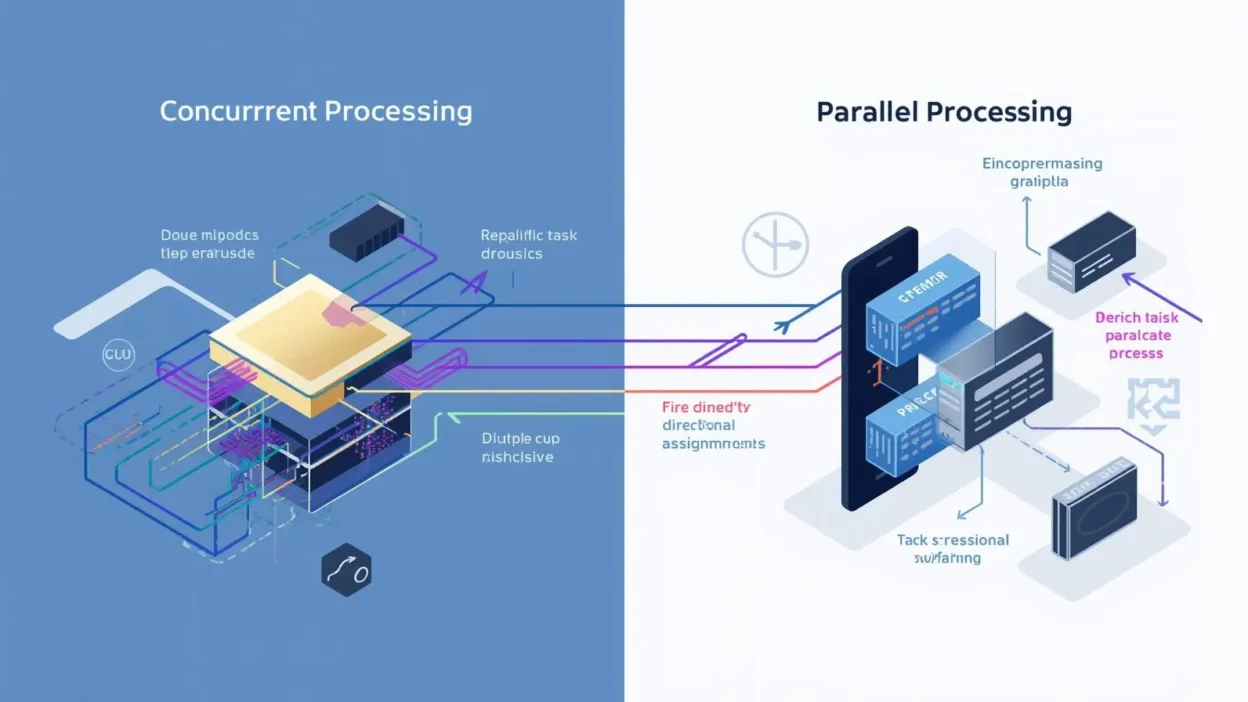
Introduction
In the modern-time and age of high activity and digitalization, computers do many things simultaneously to ensure that things are running smoothly. But have you ever thought how it is done? The notions of concurrent and parallel processing are introduced here.
Although they are similar, their differences are significant and they influence the ways in which computers handle and perform functions.
This article will deconstruct the parallel processing world, define what concurrent and parallel processing are and make the distinction between the two ideas easily using simple illustrations. No matter what you are, as a student, professional, or just interested, these concepts will be straightforward and clear with the help of this guide.
What Does Can parallel Processing mean?
Concurrent processing is the capability of a system to handle several tasks within it through permitting the tasks to progress through time simultaneously. It is like throwing multiple balls in the air where the processor is alternating between activities very fast giving the impression that things are occurring simultaneously.
- Activities in concurrent processing might not be executed at the same time.
- The system oversees several processes through efficient sharing of resources.
- Single-core processors Often used in fast switching between tasks.
- Simply, concurrent processing is concerned with dealing with multiple tasks by interweaving them.
What Is Parallel Processing?
Parallel processing on the other hand refers to carrying out two or more tasks in literal sense at the same time. This can be done when a system has several processors or cores and can execute several operations at the same time.
- Every task operates on a different processor or core.
- It is much faster when it comes to processing, particularly with large or complicated operations.
- Multi-core CPUs and supercomputers can be used to perform parallel processing.
- Consider parallel processing to be a group of workers who have to do a job at the same time but in different locations.
Concurrent Processing vs Parallel Processing: Key Differences
Understanding the difference between concurrent vs parallel processing can be easier when we compare their core characteristics:
| Aspect | Concurrent Processing | Parallel Processing |
| Execution | Tasks progress by interleaving | Tasks run simultaneously |
| Hardware Requirement | Can run on single-core or multi-core CPUs | Requires multi-core or multiple processors |
| Task Overlap | Tasks overlap in time but not exact time | Tasks overlap in both time and execution |
| Use Case | Managing multiple I/O or user requests | Heavy computation or data processing tasks |
| Complexity | Focuses on managing task switching | Focuses on dividing work for speed |
The Workings of Parallel Concurrent Processing?
Parallel concurrent processing is a concept that leaves many people confused. It is a synthesis of the concepts of concurrency and parallelism:
- Concurrency enables the concurrent execution of several activities that overlap with one another.
- Parallelism takes two or more tasks to be performed by different processors simultaneously.
- Combining these two concepts, the systems make multitasking and accelerated computation possible.
- A typical example is that a multi-core processor will be able to execute multiple tasks simultaneously whilst also managing the internal processes of the tasks at the same time.
Examples of Concurrent and Parallel Processing in the Real Life
- Examples of Concurrent Processing.
- The example of a one-core CPU alternating between music play, downloading a file and scanning a virus.
- A web server is a server that is used to serve multiple users by rapidly switching.
Merits and the Demerits of Concurrent Processing vs Parallel Processing
- The merits of Concurrent Processing.
- Good utilization of the system resources.
- Increased user application responsiveness.
Single-core systems are easier to implement
- Weaknesses of Concurrent Processing.
- Slower on tasks which are CPU intensive.
- Should be handled keenly to prevent such conflicts as deadlocks.
- Benefits of Parallel Processing.
Greater speed in performing computational tasks of heavy load
- Can scale to the additional processors.
- Enhances performance of large data application.
- Negativity of Parallel Processing.
- Needs a hardware with more than one core or processor.
- Complexity in programming is augmented.
- Co-ordination overheads.
Parallel and Concurrent Processing: The Relations You ought to know
The following are some of the key words related to our subject matter:
- Multithreading Multiple threads will run within a single process and usually through concurrency.
- Multiprocessing: RH Involving the use of more than a single CPU or core to run processes simultaneous with processes executed in other cores running separate processes.
- Synchronization: Control of usage of shared materials to eliminate conflicts.
- Deadlock: Waits on Multitasks Cause waiting to occur infinitely Multitasks (Parallel Tasks) Multitasks represent are waits between tasks or threads that are running currently.
- Parallel processing: The performance increase of parallel processing.
Which process should be used Parallel Processing or Concurrent Processing?
Parallel or concurrent processing is a choice dependant upon the problem to solve:
Parallel processing is used when tasks are largely independent and there is a wait, e.g. I/O operation, user interface.
Parallel processing should be used on tasks which require significant use of the CPU and which can be broken down into smaller bits and therefore run concurrently, e.g., mathematical computations or video encoding.
Difficulty in Concurrent Processing and Parallel Processing
There are issues associated with both types of processing:
- Concurrency problems: Synchronization problems, Race problems, Deadlocks.
- Parallelism problems: Mission allocation overhead, load balancing, the inter-processor communication overhead.
- To manage such problems, proper programming and system design are essential.
Table: Comparison of Concurrent and Parallel Processing Use Cases
| Use Case | Concurrent Processing | Parallel Processing |
| Web server handling requests | Yes (task switching for multiple users) | Sometimes (if multiple cores available) |
| Video game rendering | Limited | Yes (graphics processed in parallel) |
| File downloading and UI updates | Yes | No (typically single-threaded UI) |
| Scientific simulations | No | Yes (divided among processors) |
The ways Programming Languages Aid Concurrent and Parallel Processing
Most of the current programming languages offer means to work with concurrency and parallelism:
- Java: Linar threads and parallel streams.
- Python: Theater number capturing and multiprocessing.
- C +: Supports multithreading using the standard relay symbol of thread and parallelized algorithms.
- Go: Native lightweight multitasking through concurrently executable code.
This is because of the issues of selecting the appropriate tools based on the requirements of your application.
Best Practices on Concurrent and Parallel Processing
In order to optimize on such processing methods, keep the following tips in mind:
- Have an awareness of tasks that can be done independently and executed in a parallel manner.
- Take care of synchronizing very aptly in order to prevent conflicts.
- Protest well against race conditions and deadlocks.
- redistribute work so that you have balanced loads among the tasks.
- Track performance on a regular basis.
Conclusion
It is important to know the difference between parallel and concurrent processing to maximize the utilization of computers in dealing with two or more tasks. Whereas concurrent processing is concerned with time-sharing of resources in the management of multiple tasks, parallel processing is concerned with the simultaneous running of tasks in order to achieve faster results.
Each of them possesses its own benefits and difficulties, and understanding when to apply one or another will result in the significant enhancement of the system performance and the user experience. Be it a developer, student or tech enthusiast, whether you are or have an interest in the computing world then understanding such concepts is mandatory in the modern computing system.
FAQs
Q1: What would be the key difference between two modes of processing; concurrent and parallel?
A concurrent processing works as a time-switch between multiple tasks whereas parallel processing works as a simultaneous tasks or specific processor and cores.
Q2: Is it possible to do concurrent processing using a single core?
It is true that single-core processors can support concurrent processing although they can achieve this illusion by simply alternating between tasks.
Q3: does parallel processing need any special hardware?
Yes, parallel processing usually needs the use of multi-core processing units or multiple CPUs to run the tasks in parallel.
Q4: What is meant by parallel concurrent processing?
It is defined as those systems that are a combination of concurrency (handling several tasks at a time) and parallelism (handling several tasks at once) to enhance efficiency.
Q5: Which is superior; concurrent or parallel processing?
It is not better than either, but rather a task. Concurrent processing is useful in tasks of waiting or I/O whereas parallel processing is in heavy and divisible computations.